
The Second Crow
On Arki, people used to tell of crows that waited for lambs to be born before attacking them in pairs. The first attacked the lamb's hindquarters until it bleated. The second waited for it to open its mouth, then tore out its tongue. Unable to call for the shepherd, the lamb was slowly devoured.
Gerasimos Smyrnakis recorded this story at Easter in 1914. He did not specify whether he had witnessed such attacks himself or heard about them from the islanders. Crows are known to prey on newborn animals, sometimes attacking their eyes and other soft tissues, but there is no corroborating evidence for the coordinated behaviour described on Arki. The sequence of actions may have been reconstructed from the animals' wounds, or gradually refined through the shepherds' accounts.
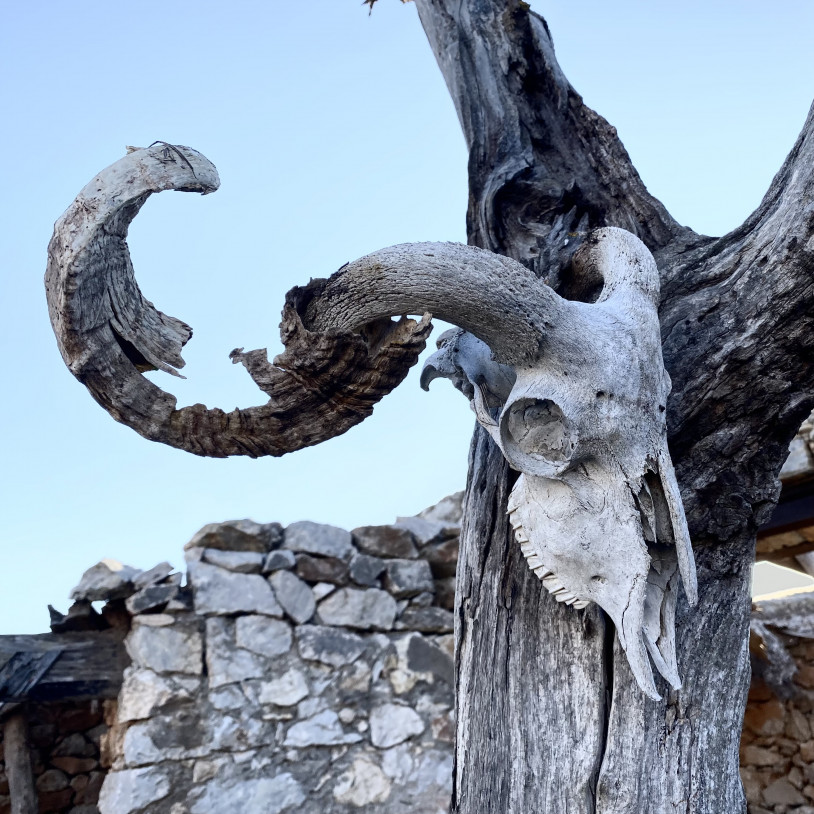
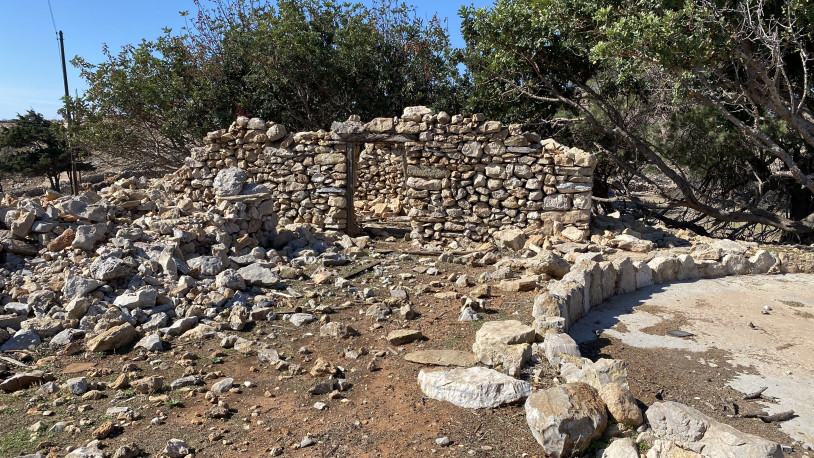
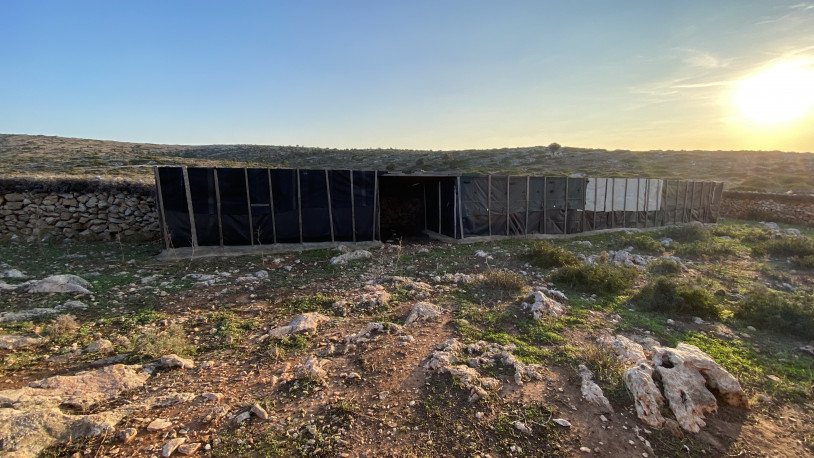
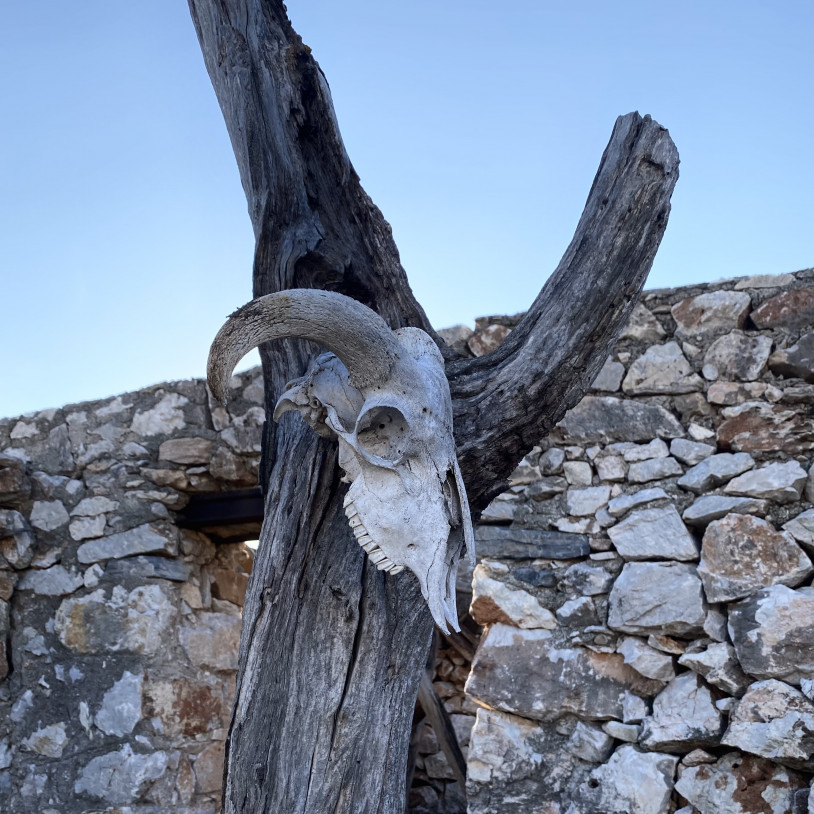
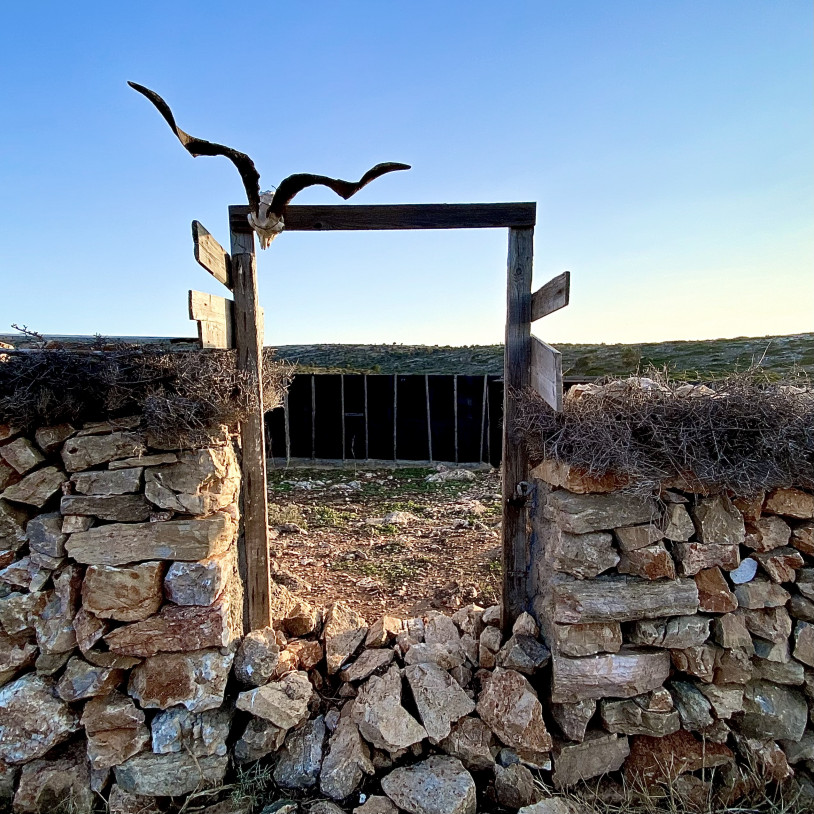
At the time, some five hundred sheep and goats lived on the island. The grazing grounds were divided by dry-stone walls, many of which can still be recognised. Among the abandoned structures are wooden feeding troughs, partially collapsed enclosures, openings, and stones stacked without mortar. An animal skull, its horns still intact, hangs from a tree; another has been placed above the entrance to an enclosure. We do not know when they were put there, or whether their display reflects a local custom. They may have been preserved for reasons entirely unrelated to predators.
The detail of the tongue appears in Smyrnakis's account with unusual precision. The second crow does not intervene while the first attacks the lamb, but waits until pain forces it to make a sound. The bleat, which should reach the shepherd, immediately precedes the loss of its voice.
Smyrnakis attributes a division of labour to the two birds, although we cannot know whether this reflects their actual behaviour or the islanders' interpretation of it. In the story, however, the attack depends on the lamb still being alive when the second crow approaches.
The Thirtieth Day
Mandrake grew abundantly on Arki. Its fruit ripened in April, turning golden and giving off a scent resembling that of a melon. The plant had low, fleshy leaves, musky-smelling flowers, and roots whose branching forms beneath the ground could resemble those of a human body.
The islanders used these roots to treat chronic wounds and fistulas. They crushed them into a powder and used it in a milk-based preparation, administered in progressively increasing quantities over forty days. According to Smyrnakis, who recorded the practice in 1914, the wound would begin to wither around the thirtieth day. The same powder was also applied directly to the lesion.
To wither. We do not know whether the word belonged to the islanders' description or to the scholar's own language. A wound that refuses to heal is treated with a root, and the anticipated change is described in the language of plants.
Mandrake contains highly toxic substances capable of causing severe poisoning. No individual accounts survive that would allow us to establish the outcomes of the treatment. The islanders, at least partly aware of the danger, resorted to a liquid prepared from ashes when they feared the effects of the plant, believing it to be an antidote. There is no evidence that it was effective.
Ashes also appear among the remedies used for scorpion stings. According to Smyrnakis, scorpions were numerous near the cistern at Sterna and on the hills above Agous. In these cases, ashes were mixed with oil; another treatment involved tobacco moistened with alcohol. These were substances available on the island, applied to the body under different circumstances, according to practices whose origins are undocumented.
What particularly struck Smyrnakis was the abundance of mandrake on Arki. He went so far as to suggest that the name Narkioi, attested in Byzantine documents, might derive from the plant's narcotic properties. The islanders, by contrast, proposed a derivation from archē, meaning beginning or origin, regarding Arki as the principal and most fertile of the islands in the archipelago. Neither etymology has been established, and it is impossible to determine when these explanations first began to circulate.
The island's ancient name thus reappears in the description of a root that acted upon pain and consciousness, while the botanical account of 1914 has yet to be compared with the island's present-day vegetation. We do not know whether mandrake still grows in the same places, or whether anyone remembers the forty-day treatment.
The same survey mentions another plant, known as christagatha. When cut, it released a latex resembling drops of blood. According to a belief also known on Patmos, its thorns had formed Christ's crown of thorns.
The mandrake root sometimes assumed human forms; christagatha appeared to bleed when cut. Smyrnakis recorded both plants, alongside others used for food and in folk medicine.
Among these he also mentioned agriokarpouza, whose pale root resembled a small watermelon and was used, according to the islanders, to treat stomach ailments. He recorded the local names of many species, some of which are difficult to identify with certainty in present-day botanical nomenclature.
For mandrake, however, a number of unusually precise details survive: the ripening of the fruit in April, the preparation of the root, the duration of the treatment, and the gradual increase in the quantity administered. And the thirtieth day, when the wound was expected to begin changing.
Not Even a Branch
On 27 August 1780, the Monastery of Saint John the Theologian on Patmos leased Arki to the monk Nikephoros for four years, at an annual rent of eighty piastres. During that period, no member of the monastic community, not even the abbot, was permitted to take anything from the island without the tenant's consent. The prohibition extended to a single branch.
The clause covered every resource, down to the smallest part of a tree. It made no distinction between green wood, dead wood, or branches already fallen to the ground. We do not know whether this was a customary provision in monastic leases or a response to earlier disputes over the use of the island.
In 1828, forty-eight years later, the same monastery reported to the Greek authorities that not a single tree remained on Arki. According to the complaint, they had all been set on fire by inhabitants of neighbouring Samos, without permission. The document does not indicate when the fire was supposed to have occurred, nor does it allow us to verify whether the destruction had indeed been total.
Trees reappear in a contract from 1896, when a new tenant undertook to plant new ones and return the land in better condition than he had found it.
In 1928, during a visit to the island, an Italian officer recorded wild olive trees, some of them grafted, along with carob trees, mastic trees, almond trees, fig trees, and prickly pears.
The surviving documentation does not allow us to reconstruct what happened to the vegetation between these dates. A fire reported but never precisely located; a contractual obligation to plant trees; a subsequent inventory of species. The trees may have been planted, grafted, allowed to grow naturally, or may have survived earlier destruction.
Their presence also endured in place names. Sykia recalled a fig tree growing near the cliffs; Cape Koumaros referred to a grove of strawberry trees, while Kapsaliasmenos, the burnt one, preserved the memory of land marked by fire.
We do not know when these names were given, whether they derive from isolated events or from features of the landscape that were once more apparent. The fig tree that gave Sykia its name may have disappeared long before the trees recorded in the twentieth century. The place known as the burnt one may refer to a fire other than that reported in 1828.
Under the contract of 1780, Nikephoros's rights were to last only four years. The prohibition against taking even a single branch has survived in the monastery's archives for more than two centuries.
The Impermeable Hill
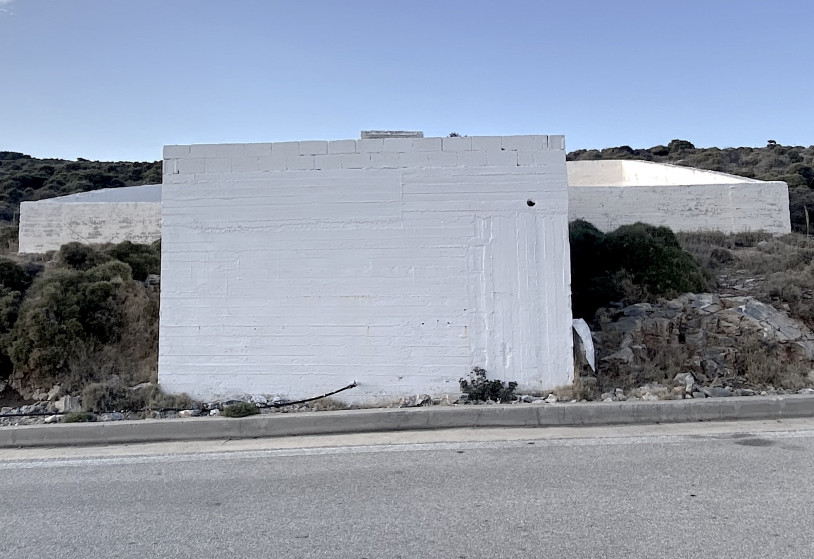
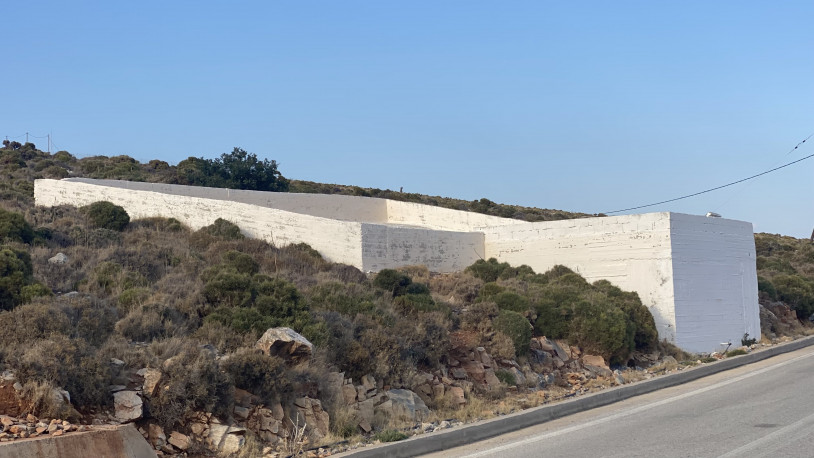
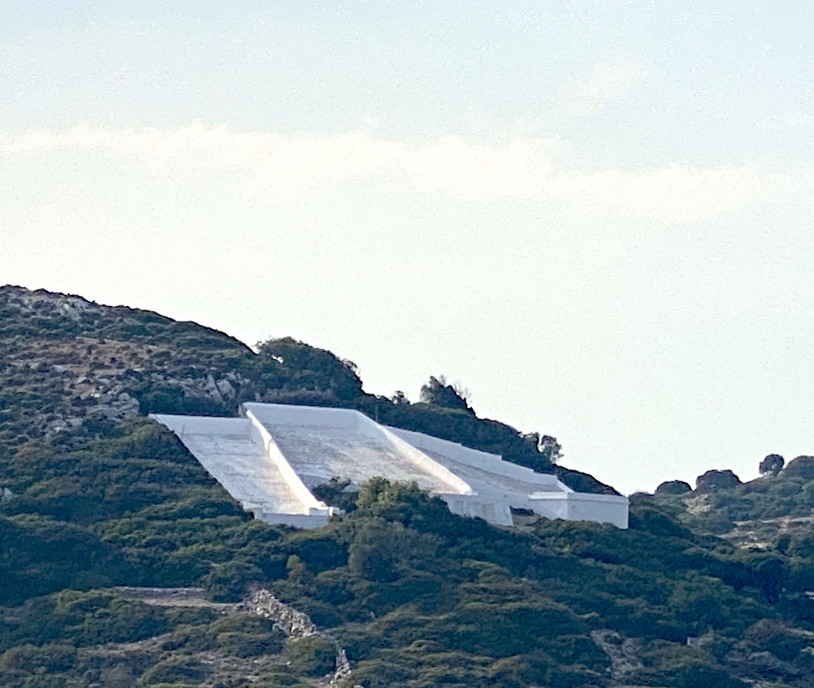
From the road, it looks like a white wall built to interrupt the hillside. Approaching it, one discovers that it does not enclose a building. The concrete extends beyond the wall, spreading across the ground in broad inclined surfaces separated by low embankments. The natural slope has been preserved; the ground itself, however, has been covered and made impermeable. Rain falling on these surfaces is no longer absorbed by the earth, but flows in the direction determined by the walls.
On Arki, the springs were predominantly brackish. For a long time, the inhabitants collected rainwater in natural depressions and in cisterns built to retain it.
In the nineteenth century, Daniel Sychnis, superior of the monastery on Patmos, had a cistern constructed to collect the small streams that formed during rainfall. Families sometimes walked fifteen or twenty minutes to reach it. They went there to fill their containers and wash their clothes.
In 1938, a contract stipulated that each inhabitant could draw four containers of water per day. Their capacity was not specified. The entitlement would cease once a public cistern had been built.
The amount of water available thus depended not only on rainfall, but also on the capacity of the containers, the time required to reach the cistern, and the conditions imposed by whoever owned the land.
Other water-collection structures were built during the twentieth century. The survey of the industrial heritage of the Dodecanese records inclined surfaces on Arki covered with cement mortar, bounded by low walls and connected to reservoirs situated further downhill. One of these structures, dated approximately to 1976, collected rainwater over an area of eighty square metres. It has not yet been possible to identify it with certainty among the structures photographed.
Seen from within, the great white surface has something incongruous about it. The embankments delineate a succession of spaces without walls high enough to enclose a person; the floor slopes too steeply for habitation. In places the covering has worn away, exposing the material beneath. Elsewhere, small cracks, deposits, and dark stains have appeared. Vegetation stops at the edges and returns wherever the concrete has deteriorated.
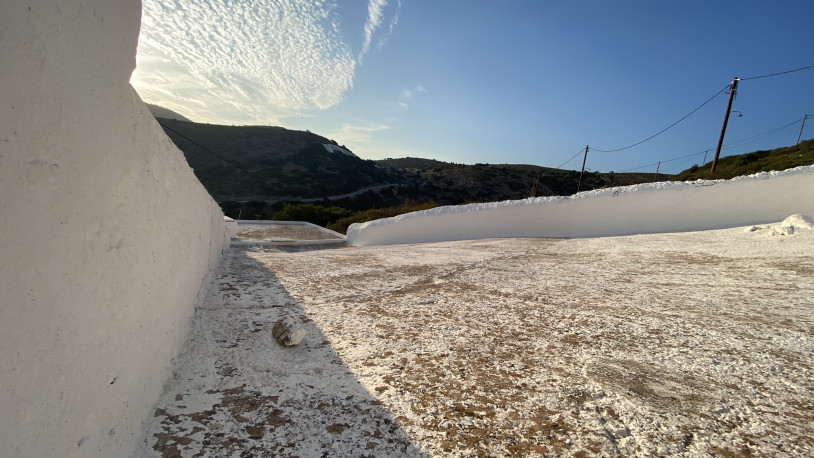
The structure seems above all to preserve the memory of a direction. Every surface is oriented so that something may pass across it and descend towards a lower point. It does not matter where the rain comes from, provided that, once it has fallen, it cannot choose where to go.
For years, fresh water continued to reach Arki aboard water tankers. In 2012, the activation of a desalination plant was announced, but subsequent government documents indicate that the works necessary for its operation were not completed until 2017. The island could now obtain drinking water from the sea rather than wait for it to arrive from elsewhere.
In June 2023, several inhabitants reported that the water-supply pipes had been broken for months. Water was escaping from the pipes and running down the roads, while the reservoirs remained almost empty.
Michalis Kamposos, a livestock farmer on the island, explained that there were two large cisterns, with respective capacities of five hundred and two hundred cubic metres. Repairs seldom lasted: as soon as one leak was fixed, another appeared. To water his animals, he had begun drawing water again from a friend's private cistern, transporting it in a drum, just as his grandmother had done.
At the same time, water drawn from the sea and treated to make it drinkable was escaping before it could reach the houses.
The concrete surfaces built to intercept the rain remained on the hillside. The pipes, meanwhile, could no longer contain the water. It continued to descend, following the slope of the island, until it reached the sea.
Place of Birth
In 1938, Arki had sixty-six inhabitants. Not one of them had been born on the island.
Some shepherds had lived there for fifty or sixty years, but women travelled to Patmos, Leros, or Lipsi to give birth, often staying with relatives. Every family also owned a house on Patmos.
The Italian statistician Livio Livi recorded this circumstance during a demographic survey. The figure referred only to those living on the island that year and does not allow us to establish how long the custom had prevailed.
The families lived in small stone houses, raised animals, and cultivated what little land was available. Travel between the islands was undertaken mainly in rowing boats or sailing vessels. Some children spent periods on Patmos in order to attend school.
In 1938, every inhabitant of Arki had a place of birth other than the island on which they lived. Not necessarily a different origin, nor a different sense of belonging. Merely another place entered in the records.
Columns
Off Cape Koumaros, at a depth of between forty-five and fifty-two metres, lie the remains of a cargo consisting mainly of columns and architectural elements. They were documented during an archaeological survey in 2010, together with traces of a vessel that sank in Late Antiquity.
We do not know where the stones came from. They may have been newly worked or removed from an earlier building. The available sources do not allow us to identify the quarry, the port of destination, or the building in which they were intended to be used. It also remains unclear whether the cargo was homogeneous or included materials from different sources.
Before the shipwreck, the columns had been extracted from the rock, worked, and transported to the vessel. To cross the sea, they had to be arranged within the hull, laid down and secured so that their weight would not compromise the stability of the ship.
During the voyage, they supported nothing. They were themselves a weight that had to be supported.
The ship sank off Arki.
Water filled the spaces between the stones and slowly altered their surfaces. We do not know the original arrangement of the cargo, nor whether the columns have remained close to the positions they occupied within the hull. Establishing this would require access to the complete documentation of the wreck, the measurements of individual elements, the nature of the stone, and any surviving traces of workmanship.
A column can be recovered, transported again, and incorporated into a building other than the one for which it was originally intended. Stones often retain traces of later uses: cuts, adaptations, reworked surfaces, inscriptions, joints no longer needed. In some cases, these marks make it possible to reconstruct movements that occurred centuries apart.
We do not know whether the columns of Arki had already had a previous life before the shipwreck.
In the same area, but at shallower depths, another wreck has been identified, carrying a cargo of Byzantine amphorae. The vessels, most of them broken, form concentrations on the rocky seabed; some of the material lies further down, on the sand. The two shipwrecks belong to different periods and no connection between them has been established.
In both cases, Arki appears as the place where a shipment was interrupted. Neither ship may ever have been bound for its harbour.
We do not yet have a sufficiently detailed inventory of the columns to imagine how they might have been arranged in the building for which they were intended. We do not know the diameter or length of the shafts, whether bases or capitals were present, or whether some stages of the stonework remained unfinished.
At a depth of between forty-five and fifty-two metres, this information may still be legible on the stones.
Note: The documentation includes notes and materials gathered through field research, meetings and conversations with local residents, alongside bibliographic research and further reading, together with photographs taken during the study trip to Greece between mid-September and 7 November 2021.
The materials presented document an ongoing research process and form part of an evolving archive, whose contents will continue to be expanded, developed and revised until the completion of the final artwork, scheduled for late 2029.